Fitzroy Christian (Interview 3)
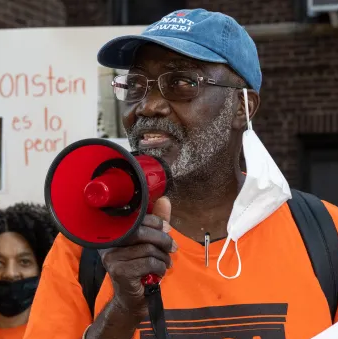
From his youth in an Antigua and Barbuda fighting against colonial domination to his retirement years in a Bronx battling gentrification, Fitzroy Christian has always known which side of the struggle to join. His oral history interviews showcase his lifelong commitment to organizing collectively for social justice. He reached out to CASA for support in 2010, when his building’s tenant association was trying to get the landlord to restore their gas provision. Christian immediately identified with CASA’s democratic model and goal of promoting safe, affordable, and stable housing. In these interviews, he reflects on the multiple campaigns he has joined as a CASA leader, outlining the challenges and promises of community organizing and coalition building. A South Bronx resident since the mid-1970s equipped with the analytical eyes of a political anthropologist and a youthful anticolonial passion, Christian shares a treasure trove of knowledge about the borough, the city, and the possibilities of progressive social change.
During his formative years in the 1960s, Christian became deeply involved in the movement for national liberation in his native Antigua and Barbuda. He drew on the example of his own parents, who had been active in the movement, as well as of prominent African intellectuals and revolutionaries similarly fighting against colonial powers at the time. Christian became one of the founders of the Afro-Caribbean Liberation Movement and helped forge alliances to like-minded groups across the globe. His political protagonism and transnational connections were awarded with a scholarship to study political anthropology at the City College of New York, where he arrived in 1971. Activism took him to New York City; as soon as he landed, he immersed himself in the local activist scene. On campus, he joined a call for the creation of a Black Studies program. Off campus, he closely observed and occasionally contributed to community efforts to rebuild a Bronx afflicted by endemic arson, a landscape of devastation ever since “seared” in his memory.
By 2025, Christian had lived in the same rent-stabilized apartment in the South Bronx for about fifty years. His long-term tenancy can be attributed to his community organizing. In 2010 he and his neighbors had been struggling for months with a cut-off gas supply, an issue that required major refitting works in the building but to which the landlord only responded by offering hot plates. “I decided that I was going to organize my building to form a tenant association [TA], and, as an association, meet with the landlord to get things done and to give us back the dignity we had as families who are paying rent.” Asking council members for a local organization that could assist them, Christian quickly found CASA and just as quickly fell in love with its work. “I loved what I was hearing and the participation of the community members, how they were the ones who were making decisions.” He joined CASA in 2010 and soon became a leader. With CASA’s support, his building’s bilingual TA managed to pressure the landlord to restore the building’s gas provision. Since this win, the association has died out, which Christian partly attributes to the high turnover rates orchestrated by the landlord’s predatory practices. Still, Christian introduces himself to new neighbors and connects all those facing housing issues with CASA for support.
When Christian joined CASA, the initiative was focused on building its base. Once it began organizing major public-facing campaigns in 2012, he got involved in all of them. The first one, targeting injustices in housing court, was prompted by CASA members’ repeated complaints about experiencing abuses and disorientation during their eviction proceedings. Christian details the different steps taken by CASA in orchestrating this campaign, from its initial reaching out to relevant researchers and lawyers, to the carrying out of CASA’s own surveys and observations in the Bronx Housing Court, the consolidation of their main findings in an influential report called Tipping the Scales, to the dissemination, campaigning, and coalition-building efforts based on the report. He stresses how CASA’s work paved the way for housing court reforms facilitating tenants’ understanding of legal procedures and curbing landlords’ attorneys’ chances of manipulating them into signing unfair stipulations. Christian stresses how CASA’s campaign also revitalized a long-term call for low-income tenants’ right to legal representation during eviction proceedings in housing court, commonly referred to as tenants’ right to counsel.
Christian’s narrative gives us a behind-the-scenes view of the efforts undertaken by community organizations that allowed for the 2017 signing of the Universal Access to Legal Services Law by then-Mayor Bill de Blasio. This legislation made New York the first city in the United States to guarantee low-income tenants access to free legal representation in housing court. He explains the struggle behind the terminology of the law itself—what tenants lose by having it be called “universal access” rather than a “right” to counsel—as well as the main arguments CASA deployed for substantiating the legitimacy and necessity of the right. Christian celebrates the success of the law’s initial implementation, which allowed the city to save substantial resources and an estimated eighty percent of represented tenants to stay in their homes. He details how the planned rollout of the law was disrupted by the covid-19 pandemic and the introduction of a series of eviction moratoria until mid-2022. The resulting significant backlog of eviction cases since then has led to a shortage of attorneys, harming tenants’ access to legal representation in the city. CASA’s activism has sought to respond to this problem by targeting the city and the state simultaneously: “We are pushing to strengthen and to preserve the New York City’s Right to Counsel as it is. At the same time, we are pushing for a statewide version, which will supersede the city version, but will bring on with it a lot more rights and powers of funding that we can get for ourselves here in the city.”
Alongside these efforts, Christian outlines how CASA and its coalition partners have been pushing for the Clean Hands Bill and a reform of the Rent Guidelines Board. Both would allow low-income tenants greater housing stability: the former protecting them from eviction cases when their homes are in violation of housing maintenance codes; the latter democratizing an institution that decides on yearly adjustments to the rates of rent-stabilized apartments.
Since the pandemic, CASA has led an influential campaign called Eviction-Free Bronx. Christian lays out the rationale behind and the timing of this call in the interviews. “We always knew that evictions were inhumane, and we were always fighting evictions. […] It is just that with the pandemic, it struck us how poorly we were treating our fellow citizens, our fellow residents in New York City.” He outlines how CASA has joined different coalitions in pressing for eviciton moratoria (during the pandemic and winter months) and an end to the chronic displacement of communities.“Because we're saying eviction is violent. It is very disruptive to the individual, to the family, to the community, and, eventually, to the city and the state. And we think that evictions should be something of the past.” He explains how CASA has been looking at social housing programs in Europe and South America as a possible alternative housing policy that could help abolish evictions in the Bronx, in the city, and beyond.
Christian’s long-term tenancy in the South Bronx and his community engagement have afforded him an encyclopedic and critical perspective on urban development in the borough and New York City. Across the three interviews, he shares glimpses of his panoramic view of the South Bronx’s place in the governing elites’ long-term attempts, from the mid-twentieth century until recently, to realize a “whitening” or “decolorization” of the city. He discusses major urban works, rezonings, and economic restructurings that have, over the decades, pushed low-income communities of color out of their homes and undermined or consistently threatened their ability to flourish and build intergenerational wealth. He situates the rezoning of Jerome Avenue, approved in 2018, in this long-term view. He describes how CASA got together with a wide variety of community organizations (such as trade unions representing local schoolteachers and construction workers) to offer an alternative vision of development that would allow residents to stay and thrive. He acknowledges the difficulties in sustaining a coalition with such varied partners representing often clashing priorities. Still, he upholds coalition-building as essential to combatting displacement. He observes the construction of privately-owned buildings since the approval of the rezoning, and the increasing arrival of whiter, wealthier, and transient young residents demanding greater policing.
Contemplating the future of the South Bronx, Christian sees both danger and promise. He observes how the borough’s low-income community of color has been made “nomadic,” how people’s sense of “hominess” has been systematically threatened over the decades. He laments how currently the community “not even remotely resembles what it what it was twenty, twenty-five years ago.” At the same time, he envisions the possibility of this very community getting together in a Bronx-wide coalition to press for their own wellbeing. This, Christian believes, would require people’s greater political participation, both through publicly-funded grassroots organizations and through a significantly increased turnout during elections. It would also require the fostering of alliances across different groups with different priorities who nonetheless stand for the community’s stability. “That is the future I see. And that is the challenge for us. How can we do those things to make the Bronx a beacon for what is possible, especially for people in marginalized communities that have been pushed aside and ignored?”
Coalition building
Community organizing
Covid-19 pandemic
Eviction
Gentrification
Homelessness
Housing court
Landlord neglect and harassment
Rent-stabilized apartments
Rezoning
Right to Counsel
Social housing
Tenant associations
Voting and electoral organizing
Andrew Cuomo
Bill de Blasio
Daniel Patrick Moynihan
NHD (Association for Neighborhood and Housing Development)
Clean Hands Bill
ERAP (New York State Emergency Rental Assistance Program)
Housing Justice for All coalition
HSTPA (Housing Stability and Tenant Protection Act)
MCI (Major Capital Improvement)
New Settlement
Northwest Bronx Community and Clergy Coalition
Nos Quedamos
Office of Court Administration
Rent Justice Coalition
RGB (Rent Guidelines Board)
Right to Counsel New York City Coalition
UAC (Universal Access to Counsel)
Upstate Downstate Housing Alliance
Winter Eviction Moratorium (S1403A and A4093)
Woodside on the Move
Albany, New York
Bronx, New York
Jerome Avenue, the Bronx
Campaign for a winter eviction moratorium
Campaign for Right to Counsel in New York City
Campaign for Right to Counsel in New York state
Eviction-Free Bronx
Rent Guidelines Board campaigns
| time | description |
|---|
00:00:46 | Christian explains the Clean Hands Bill and the reasons why CASA has pushed for its passing. Connects it to other bills CASA is similarly mobilizing for, including the passing of a statewide Right to Counsel.
00:08:29 | Introduces CASA’s Eviction-Free Bronx campaign and its accompanying call for a moratorium on evictions during the winter. Expresses his critical view on evictions and the need for social housing in New York.
00:12:07 | Discusses the origins of the Eviction-Free Bronx campaign during the pandemic and how it has inspired CASA to push for evictions to become obsolete in all of New York City and state.
00:16:51 | Outlines CASA’s arguments for a reform of the RGB (Rent Guidelines Board) to make it more democratic. Stresses how this demand ties into CASA’s other campaigns, which together press for the right of low-income people of color to stay in their homes and communities.
00:22:17 | Clarifies how CASA has always operated on the premise that evictions are inherently inhumane and should not exist, but that the emergency conditions brought by the pandemic pushed this belief and demand to the forefront.
00:26:25 | Elaborates on his critique of how the different levels of government (from the city to the federal) do not adequately use tax funds to provide affordable housing. Criticizes tax incentives given to private developers to build new housing. Points to alternative models, based on social housing, in other countries as inspiration.
00:39:10 | Describes the different coalitions and organizations with which CASA works in pressing for housing justice.
00:45:13 | Mentions CASA’s limited prospects for passing progressive housing bills under the current legislature and government, but expresses hope for greater opportunities by the 2028 elections.
00:48:29 | Recounts the efforts to build a broad coalition of community organizations across New York state for a revision and strengthening of the rights of tenants of rent-stabilized apartments. Stresses the emergence of the Housing Justice for All coalition and the main victories obtained by tenants with the passing of the Housing Stability and Tenant Protection Act (HSTPA) of 2019.
00:56:27 | Christian reflects on some of the lessons he has learned from decades of community organizing in the Bronx. Stresses the central importance of tenants’ protagonist action in promoting the well-being of their community. Argues for greater and sustained public funding of community organizations like CASA. Highlights the power lower-income tenants have over politicians as voters, given their high numbers.
01:03:29 | Christian explains his concern that the majority of the communities of color residing in the South Bronx have not participated in elections as much as he believes they should in order to exert pressure onto politicians.
01:07:49 | Discusses his vision for a future Bronx built on community participation, where residents have access to social and stable housing and are no longer threatened with displacement. Stresses the need for investment in the creation of a whole ecosystem of opportunities (in the areas of work, health, education, etc.) so that people can thrive in the borough. Reflects on the need to build a Bronx-wide coalition to that end and expresses hope that, as with the successful struggle for Right to Counsel, the Bronx can be a standard-bearer for housing justice in New York and beyond.
[01:14:02] Reflects on the challenges inherent in building wide coalitions with partners having different interests and priorities. As an example of such challenges, draws on the experiences of the Bronx Coalition for a Community Vision during the campaign for the participatory rezoning of Jerome Avenue.
Zacca Thomaz: Today is April 9th, 2025. This is Diana Zacca Thomaz from the University of Amsterdam. I'm interviewing Fitzroy Christian from CASA on Zoom for the third time. This interview is for the Parsons Housing Justice Lab’s Oral History Project. Fitzroy, thank you so much for joining me once again to discuss your role with CASA. In our last session, we stopped when you were explaining about the Clean Hands Bill and the campaign that you've been participating in to push for it. Can you tell me more about this campaign and the bill itself?
Christian: Sure, and good morning again. The Clean Hands Bill, we are pushing aggressively this legislative session for two reasons. One, we think it was truly unfair that landlords could have taken—or they still can take—tenants to court to have them evicted for various reasons—whether because they are behind in their rent, or allegedly behind in their rent, or because the landlord believes that they may be in a breach of their lease, that they violated the lease and they take them to court. But in the meantime, the landlords themselves have several serious violations in the building, in the apartments. And we think that the playing field should be more even. It should be more just. That the landlords should not have dirty hands, in the sense that they are in violation of the city’s and the state’s building codes; that they are in violation of the warranty of habitability laws; that they can neglect their legal obligations to provide clean, safe, healthy, habitable apartments to tenants in exchange for their rents. And, at the same time, trying to bring eviction proceedings against the tenants because the landlord is alleging that the tenant is in violation of the lease. That needs to be corrected. That needs to be evened out.
And the other reason why we are pushing it is because it costs nothing to the state or city. It is a non-money legislation. It's just a law that says, “You as a landlord cannot do this if your hands are dirty. You must come with clean hands, and then we will listen to you in court as you try to move these proceedings along against your tenants. You cannot have dirty hands and come here and expect us to take action or give judgment in your favor when your hands are dirty.” It costs nothing to the state or the city, and it also evens the playing field and brings a sense of equality, of justice to the tenants, that they are protected by the law. It says, “the landlord cannot do this if their hands are dirty.” We think it is something that can be easily passed this session, and so we are pushing that very aggressively.
The Clean Hands Bill by itself would be nice to have. It is something that we would love to have and we intend to get. But it is part and parcel of a series of bills that we want to get passed. The others, of course, cost some money, but there are strong indications that the bulk of the cost would be the upfront implementation. But, over the years, the city and state will benefit. Something similar to the Right to Counsel in New York City in 2017. Everybody was very concerned about the cost to implement that program, the Right to Counsel. But it so happened that in the first year, 2018, the city realized the savings of over $300 million. And they continue to increase their savings as the program was rolled out. But, unfortunately, the covid pandemic struck and that interrupted everything that was planned. And we are now in a phase where we are in a rebuild mode, where we have to get back to where we were in 2018, 2019, so that the Right to Counsel can be working effectively at the city level. But we are pushing to have it as a state law.
We want the Right to Counsel to be statewide rather than just citywide. Because there's a lot more power coming out of the governor's mansion, coming out of the state legislature, that will cover all of New York state and will strengthen the law that we already have here in New York City. It will cost them money, but just like the Right to Counsel in New York City, most of it is gonna be the upfront implementation costs, and that will very easily be recaptured within the first couple of years. And then the state will begin to see massive savings, just as the city has seen massive savings the longer the program runs. I don't have exact numbers right now to say, since the last moratorium was lifted in June of 2022 through now, what the numbers are. Because it has not been consistent. But all of the surveys, all of the economists, all of the financial people who looked at it and who studied what happened in the city, they all agree that within a year or two, the state will recoup all of its investment in the statewide Right to Counsel. And thereafter, it will be a massive savings, because they have much, much less to spend on social services, health services, education issues, transporting kids back and forth to their schools from their shelters. And if they were to implement a real serious housing program, which will be focused on building truly affordable homes for the folks who need affordable homes at the lower end of the economic scale, [together they would] do a great job, both of them, the Right to Counsel New York state level, the Clean Hands Bill. Those [would] go far, far away in making New York state a livable place for all who live here right now, not just the very wealthy.
Then there is the Eviction-Free Bronx campaign, which, eventually, we're gonna be pushing for an eviction-free New York City campaign. Right now, we are pushing that there is no eviction whatever in the winter season [Winter Eviction Moratorium, S1403A and A4093]. Because it is really inhumane to evict a family from their homes in the snow and the cold. Pushing them from a warm home out into the snow, cold sidewalks, into shelters, disrupting their lives at that time of the year. We are actually pushing that as well. Because we're saying eviction is violent. It is very disruptive to the individual, to the family, to the community, and, eventually, to the city and the state. And we think that evictions should be something of the past. It should not be happening, which is why we are also pushing for social housing. And we have had some of our members, our coalition partners, visiting Europe and South America to see how social housing has been implemented in other places around the world. What we can learn from them so that we can implement it here in New York state itself. And especially in New York City, where we have seventy percent of the population being renters. So, if we can get social housing, as a part of the future, the near and distant future of New York City and New York state, we will be taking some massive steps towards eliminating homelessness and keeping families in their homes and communities intact, which is what we want. And the final piece of it is the reform of the Rent Guidelines Board.
Zacca Thomaz: Fitzroy, before you move to the reform of the RGB, can I ask you to go back a little bit in time and explain the origins of the Eviction-Free Bronx campaign? Because that started, if I'm not mistaken, during the pandemic, right? Can you tell me about how you started to discuss this idea of an eviction-free Bronx? What were your original demands and how they led to this current push for social housing?
Christian: You froze there for a moment.
Zacca Thomaz: Oh, do you hear me now?
Christian: Yes.
Zacca Thomaz: Okay. So, I'll repeat my question. Before you go on to talk about the campaign with the RGB, can you tell me a little bit more about the origins of the Eviction-Free Bronx campaign? Because, if I'm not mistaken, it's a campaign that started during the pandemic, right?
Christian: Yes.
Zacca Thomaz: And it was quite radical, this idea of an evict eviction-free, evictions as no longer legitimate. Can you tell me about how you came up—?
Christian: Yes. Because the Bronx, for whatever reason, has been the borough with the highest numbers of cases coming to court—eviction cases coming to court—and also has been the borough with the largest numbers of evictions. And this is also the poorest borough in the city. And the poorest congressional district in the nation, where we are in the Bronx. So, we were saying: Here it is that all of these people are losing their jobs during the pandemic because their businesses, their employers are closing down or drastically reducing staff, skeleton staff to maybe provide just a very basic services to their clients or patrons. So, these folks have no money. And the city, they had an ERAP program, a [New York State] Emergency Rental Assistance Program, ERAP, that was being administered very inefficiently. The monies were not coming through, and the landlords, during the pandemic, were taking tenants to court to evict them for nonpayment when they have no income themselves. The tenants had no income.
And so, we started a campaign that it is inhumane and just mean-spirited to be evicting people in the middle of this worldwide pandemic. The courts and the state and city should not allow this to happen. We started this campaign, eviction-free, during the pandemic.
It was part of a push to close the courts, so that the courts do not move forward with any cases. This is why we had several moratoria that were extended over six-month periods from 2020 to 2022. June of 2022 was the last moratorium. Because we believe it was really, really inhumane for the state and the courts to be evicting people during this pandemic. When the state itself was not providing the funding, even though they promised. They did not provide all the funding that they wanted to because of the economic conditions of the state.
So when we started the Eviction-Free Bronx [campaign], it was to save the tenants from being unhoused, un-homed during the pandemic. And eventually, we figured that it should be a permanent thing, that evictions are violent. Eviction does so much damage and absolutely no good to anyone, except the landlord. That we should have an eviction-free Bronx and an eviction-free New York City. And so even after the pandemic the—I wouldn't say seriousness because it is still a very serious problem, but it is more under control. It is more understood. There are a lot of, let's say, medical and scientific tools available to assist tenants to recover if they were affected by the pandemic. We say we should not ever go back to a place where evictions are an everyday, routine event. That should not happen.
So, we continue with our Eviction-Free Bronx campaign. And as I said, we intend to eventually roll it out to Eviction-Free New York City and hopefully in New York state, eventually. Where evictions become a part of the history, or the bad things that happened in New York since the beginning of the state. So that's where we are right now with the Eviction-Free Bronx campaign.
And that is part of the group of bills that we're pushing. The next one being a reform of the Rent Guidelines Board. As it is right now, the state law that sets up the Rent Guidelines Board gives the power to the mayor to appoint the nine members of the Board, the Rent Guidelines Board. As constituted now, there are two members who are supposed to represent the interests of the landlords; two members of the board who represent the interests of tenants; and five members who are supposed to represent the public interest. Now, the four members for the landlord and the tenants are generally appointed by the mayor, with some input from the landlords, for their two, and from the tenants, for their two representatives. But it doesn't matter because when the mayor instructs its members what it needs and what his plans are, you're still gonna be outvoted. So that even if, for whatever reason, the landlord and the tenants come together and say, “Okay, we agree on this result for this year's Rent Guidelines Board,” the mayor still has the majority vote. He's still gonna be getting five votes to the four votes combined from the landlords and the tenants.
So, what the mayor wants is what the mayor gets, regardless to what the landlords and the tenants wish. We are saying that that should not be. That no one person should have that power over 2.5 million tenants in the rent-stabilized industry. That it should be the power of the City Council. We are pushing to change that in the state bill that sets up the Rent Guidelines Board, where it is the City Council and not the mayor that will be appointing the members of the Board. And it's the City Council, which is a much truer representation of the people of New York City than the mayor. They're the ones who should be deciding who sits on the Board and what guidelines the Board should follow each year.
So, along with the Clean Hands Bill, the Eviction-Free Bronx, Right to Counsel in New York state, we are also pushing for reform of the Rent Guidelines Board. Because altogether, they can transform the landscape of housing in New York City, which is what we want. And eventually lead to not only a city, but a state where people can set down their roots. They become less nomadic, being evicted and living in one community, then being pushed out into another community. It gives them a sense of home, “hominess.” Maybe it's a new word I'm making up here. But when you’re settled, you will see your home, you're here permanently. And generation after generation can continue to live in that apartment, in that neighborhood. And here you can begin to create generational wealth, which is something that is not happening much in the communities of color. Because even with regulations, a lot of folks are still facing homelessness. This is something that we are pushing to end. And the only way we can end homelessness is if we have affordable homes in which people can live. In interest of time, I could stop here, and then we could move on to the next set of questions.
Zacca Thomaz: I just wanted to clarify one thing about the Eviction-Free Bronx campaign and also the campaign now for the reform of the RGB. So, the Eviction-Free Bronx campaign, as you were explaining, it started by questioning the legitimacy of evictions during the pandemic, right? You were saying it's inhumane to evict people when you have a pandemic going on. But it sounds like as this campaign evolved, you started to question the legitimacy of evictions in themselves, right? Evictions are always inhumane. Is that what happened?
Christian: No, we always knew that evictions were inhumane, and we were always fighting evictions. That was one of the reasons we started to reform the Bronx Housing Court, as I said in our earlier discussions, that led to the Right to Counsel. It was because we wanted to get attorneys for the clients [tenants], so that they could stay in their homes, so that they would reduce evictions in the Bronx. That was what the original intent was, when we said we wanted to reform the Bronx Housing Court. So, no, we were always anti-eviction from the very beginning. It is just that with the pandemic, it struck us how poorly we were treating our fellow citizens, our fellow residents in New York City. We have people who are dying. People who are being sick.
People who are being unemployed. And then the landlord and the courts are saying, “So we're going to evict you. And we're going to put your family in a shelter where so many people are sick. We are going to be endangering the lives of young people, old people. The only people who are gonna be safe are those probably of the middle class and the upper classes, because they have the financial wherewithal to isolate themselves, to do what they need to do to protect themselves, whereas so many people don't.” And now you're saying you want to evict them during this pandemic, where, through no fault of theirs, they have no jobs, they have no income? The state, under Andrew Cuomo, as governor, was not doing what was needed to be done to get the money to the different municipalities to provide the health services that were needed. And the state itself was not really administering the distribution of monies that were budgeted for people through the ERAP program to pay the landlords, so that the tenants would not face the burden.
Everything that was going on at that time was injurious to tenants and the poor. So, this is when we ramped up our opposition to evictions and decided that it should not just be a moratorium that you don't evict during the pandemic, but there should be no evictions period. And that the courts and the Office of Court Administration should do what they need to do to follow the law and make sure that tenants have their lawyers, when they're eligible for these lawyers. So that they have a much better opportunity to assert their own rights and to hold the landlords accountable for the violation of the various city statutes and the housing code laws that they're breaking. So that they have much better opportunity to stay in their homes.
Without a home, without that foundation, you can't build a family. You become a nomad in your own state. Moving from one neighborhood to another, from one borough to another. Because you're being pushed out. Because you're poor. Because, yes, the rising cost of housing, health, and education is a war against the poor. And these are things that we are fighting. And the Eviction-Free Bronx, hopefully, is the start of a massive push for an eviction-free New York. New York City first and then New York state.
Zacca Thomaz: And you mentioned that as part of this effort to make evictions something from the past, you are now focusing on social housing and trying to learn from policies implemented in South America, in Europe. Can you tell me about how you ended up on this focus on social housing and how you see social housing as part of a world, a Bronx, a New York City, a New York state that's free of evictions?
Christian: Sure. We know this is going to be a steep uphill battle because America is a bastion of capitalist greed at its worst. And here in the United States, there's going to be a massive opposition to any reduction of the ability of real estate to capitalize on housing. Even though over the years the federal government and some of the states have been involved in providing public housing, they have not been properly administered because too many of the elected officials —and in particular those on the conservative end of the political spectrum —think that everything should be left to the market. Let the market dictate what is needed. There is no need to correct something that we don't know is not working.
And as real estate [continues] to accumulate more and more wealth, which is being concentrated into fewer and fewer hands, they are driving for their traditional—if you want to use that word—laissez-faire attitude that governments should not be interfering in economic matters that are best left to the market. We know we're going to be fighting a very hard battle. The real estate industry is extremely wealthy. It's a trillion-dollar industry. It is worldwide, global. They control housing through international, multinational corporations that dictate the lives of people all over the world. So, while we are saying that we need this housing, we need to see how people around the world have responded to the need for housing in their communities.
Personally, I believe that I pay my tax, and it is the responsibility of the government who takes my tax money to provide services that I cannot provide for myself. Which means the government should be providing housing. The government should be providing education. They should be providing healthcare. They should be providing food. They should be providing the amenities, which means good transportation systems, good road systems. That is what my taxes should be going for. But here, what we have in New York is that these tax dollars, the governments—the three levels: the federal, state, and municipal levels—are extracting from workers, and especially poor workers, and are being transferred [the tax dollars] to landlords in the form of subsidies, incentives for them to build buildings and apartments in this city and state.
So rather than that money being used by the governments to actually build, they are giving it to private corporations, in terms of law, which is like a J-51—which we may or may not discuss depending on how we go along—421a, 421-g. Which are actually subsidies that the state and city provide to private real estate developers to build apartments. Apartment buildings for New York City and New York state.
We are saying that the government will be doing much better if the government itself builds those buildings. Or, instead of giving it to the major corporations, why not give it to the community developers? There are numerous instances where community developers have built homes, built neighborhoods that are sustaining at much, much lower rates than what the private corporations are providing. So, we get a lot more if the governments were to invest in the community developers, like New Settlement, like Northwest Bronx [Community and Clergy Coalition], like Nos Quedamos. There’re so many instances where communities have been built and sustained over twenty, thirty-year periods so far. But rather than continue that trend, what the governments are doing here in New York—the two levels, the city and state—they're giving the money away to private developers for a thirty-year period, and then that contract may end.
And in exchange, we're not getting much. We're getting about twenty percent of the apartments in exchange for whatever incentive the government gives to them. And that continues to contribute to the homelessness because we need a lot more housing than that. A lot more affordable housing
And we have learned, and we have seen over the years, where countries around the world approach housing completely differently, a good 180 degrees from the way the United States sees it. And they, the governments in those countries, are themselves building the homes. And they have different programs in place where they are funding, helping neighborhoods to build homes for the community, at rates affordable to the communities where those homes are being built. We want to learn as much as possible the different approaches and see which and how they can be implemented here.
The corporate welfare system that was developed here in New York City and New York state, where monies are transferred from—It's like a reverse Robin Hood, where the government is taking money from the poor and giving it to the rich. Rather than using that money that they're collecting to provide improved services to the [communities from which they have extracted billions of dollars]. So, we have the very wealthy, the super wealthy, getting tax breaks, while the poor are facing tax increases. They're facing increase in the cost of living. They're facing inflation. They're facing everything that is making life more and more intolerable for them.
But at the same time, the governments—the federal, state, and city levels—are reducing the taxes of the super wealthy. If they were to tax the rich fairly, ask them to pay their fair share of the taxes, we would have sufficient funding for the government to implement social housing, much improved health care, much better implemented education services. Would be able to provide much more for our food stability. There's so much more we could do if we were to implement a fair tax system. But especially it would help stabilize families and communities, which can stay in place and [help] to build the economy, with their employment, with their being homed permanently. They could do so much more as community members and generate wealth for the community, so the community can grow.
This is what we are looking at. How we can stabilize homes and the people's ability to live in New York City, in New York state. So that they can grow as individuals, as families. And that will extend out to communities, neighborhoods, and regions, where people can feel free that generation after generation can stay in their homes, if they want to, in that neighborhood, if they want to. But still, they are free to move to other areas. They may need to, for job or for curiosity or just to move away, get some maybe—whatever the reason. But what we need, first of all, is the foundation [on] which that future is gonna be built. And the future is not gonna be built on privatized, monetized, commoditized housing. It has to be through social housing. The very wealthy or the not so very wealthy, well-to-do folks, can always buy their condos.
They can always have their, um, three-million-dollar apartment building. Their ten-million-dollar apartments. Yes, there's nothing to stop them from buying these luxury housing, these luxury apartments. There's nothing to stop them from building a luxury apartment building. They can afford it. They can have it. That is their right. But the government should be—all three levels of government—should be focused on providing the basic housing needs, the basic education needs, the basic food security needs for the folks who don't have a couple of million dollars or a couple of hundred million dollars or a couple of billion dollars sitting down in the bank somewhere. And that is the why we're now focusing on social housing as the alternative to privatized housing that we see here in New York and in the United States.
See what we can learn from the other countries and how we can implement it and help to alleviate this burdensome homelessness, this housing crisis that we're facing here in New York City and New York state.
Zacca Thomaz: And for this campaign in pushing for social housing and also when you are pushing for a reform of the RGB, when you say “we,” is CASA working in coalition with other organizations? What does that look like?
Christian: Yes. The “we” is the several coalitions that we are a part of. Two of them that we had to form. One of them is the Rent Justice Coalition, which is comprised of organizations from around the city and upstate New York. Because upstate, we may not have the rent-stabilized system in place throughout the way it is down here. But there are a lot of mobile homes, where folks are renting the land on which their homes are built, and they are facing the same issues from the landowners. Moving them off because they're increasing the cost of the rent of the land, the same way [they increase] the rent of the apartments in the city. So, those organizations upstate and mid-state, they are part of that coalition, Rent Justice. This is not just for apartments, but for those who own their homes, their mobile homes. But those homes are on private land that they're renting, and they're facing unpredictable and high increases in the cost for renting those lands. They are part of the coalition.
There are non-housing organizations that support us. I say non-housing because their major focus is not on housing. But it touches housing because when we think of the school boards in the area and the school unions, you find that the teachers are very much concerned about the mental health and physical health of their students who come to school hungry, not properly clothed. And because of the various traumas that they are experiencing, they are not learning. So, yes, they are part of the coalition that says, “If we can stabilize my students' homes, my students' housing, then they'll be in a better position to be learning. So that as they grow up, they can become a contributing member of society.” So, yes, we have organizations that are not tenant-based, not home-oriented, not tenant-oriented that support the Rent Justice Coalition.
Because a stable home is where everything begins. We have unions, trade, construction trade unions that support it. And that's because they are parents, and they understand that if they can't have a home for their family, they can't have anything. And so they support the movement for rent justice because with rent justice, they themselves can afford to stay in the homes that they're building. And they can say, “Okay, my family can stay here now. My children are stable. They can go to school. They can learn. They can follow whatever career path that they want because we have a stable home where they can thrive.”
We have other groups from various organizations, like the ANHD [Association for Neighborhood and Housing Development] that is the association for neighborhoods and homes development, ANHD. That is an umbrella with more than a hundred members that support the Rent Justice Coalition. This is something that we get a lot of support from, from within and outside of the housing ecosystem.
Zacca Thomaz: Very good, Fitzroy. So in terms of your history with CASA and the different campaigns you’ve participated, you've discussed some of them. Are there other ones that you would like to share about that we haven't mentioned yet?
Chrisitan: Yeah. There are others that we are not pushing too hard at because we have a very conservative governor. The legislature is somewhat less liberal, if you wanna say that—though they have been very conservative and only move when they meet irresistible force from the tenant organizing movement. Those bills, we know are not gonna be passed now. We are working on them. We are developing draft bills, and we're looking for sponsors. And we are working to build support around them. I'm not gonna be mentioning them now. But, yes, there are other initiatives that we're looking at, but we are not really pushing for them to be passed this session. Probably, we will put more energy into it for the 2026 year, budget season, and 2027.
But, ultimately, we're hoping that by the time the elections come around in 2028, that we would have sufficient momentum there and support from legislators, both from the senate and from the assembly, that we can begin to actively work to get them. And then these bills come before the legislature and ultimately be passed and be signed off by the governor. But there are other things that we are looking at and other things that we are doing that we believe will help us in stabilizing housing. Reforming how housing is being [developed] here in the United States, but in particular, in New York, where we work. And all to the benefit of the tenants, the seventy percent of tenants [New Yorkers] who actually are renters, so that they can afford to continue to live in New York.
Zacca Thomaz: You joined CASA in 2010, right? When you were still building a membership before the big campaigns started. Is there a particular memory that you have from that time when you were—?
Christian: Yes. You're referring to the HSTPA [Housing Stability and Tenant Protection Act] of 2019?
Zacca Thomaz: To the what, sorry?
Christian: The HSTPA laws of 2019. Is that the one you're referring to?
Zacca Thomaz: I wasn't, but you can talk about it as well. Is there something you'd like to share about it in particular?
Christian: Yes. It took quite a few years for that to happen. After the rent stabilization laws were passed in 1969 and amended every so often, what we found was that each year—No, at first, the laws were given a sunset of four years. Which means the laws would have to be revisited every four years. And what we found was that there was a consistent reduction in the rights of tenants and an increase of the rights and powers of landlords. That more and more they [landlords] were taking rent-stabilized apartments out of the system and converting them into market-rate apartments that drove families out of their homes. Each time that the rent stabilization bills came up to the assembly, they were weakened.
And so we started a massive campaign. I should say a more organized campaign, because there are folks who are fighting it for years and years and years. There were some very, very, very minor wins. But each time that the laws came up for review, we lost a lot of the protections that were in the initial bill. And the landlords were getting a lot more added that gave them more power, gave them more rights, and reduced the powers and rights of tenants. And starting in about 2015, we had what was called the Upstate Downstate [Housing] Alliance, where instead of focusing only in New York City, we began to work with homeowners, renters, the mobile homeowners in the rest of the state who were facing the same issues that we were facing here in the city.
And in particular, the folks upstate and mid-state were a lot more conservative than what is referred to as the liberal downstate region. Our defeats came because we were not able to get the legislators from the conservative upstate to mid-state areas to understand our plight here in the city, to make them care about it. Because we had no connection with the people who live up there. Not with the people who lived upstate and not with the legislators who came from upstate.
We formed the Upstate Downstate Alliance, which eventually was renamed Housing Justice for All [coalition], which is the umbrella organization that has well over one hundred different organizations as members of the coalition. Housing Justice for All. And it was Housing Justice for All that came up with that humongous platform that we won in 2019 that completely overhauled the rent stabilized laws and gave so much more power and protection to tenants and reduced some of the power—yeah, I'm I'm gonna keep repeating that thing—the power of the landlords to continue to abuse tenants, to remove rent-stabilized housing from the rent-stabilized law, to reduce what happens with Major Capital Improvement, Individual
Apartment Improvement, with the preferential rent system. These are things that we won. And the landlords, of course, took the state and the city to court to challenge the laws. They were turned back quite a few times, but they did get a few wins. But, overall, in 2019, we were able to stop the massive bleeding that the housing industry faced—the tenant portion of the housing industry faced. We were able to get some of our old protections back in and new protections were introduced so that the stability of neighborhoods, of homes got some protection and got some—let me rephrase that.
The new laws included protections, some new protections, and restored protections that had been taken away in prior years during the reviews. And now all rent-stabilized apartments in New York City are stabilized permanently. It cannot be taken off of the system. That is part of what we won.
We also won the protection that if a landlord invests money in any Major Capital Improvement of their apartment or the building itself, that the increases that are passed onto the tenants do not last forever, but they have a sunset period. A time when the tenants would have paid a portion of those costs, and then they no longer would be paying it. So it doesn’t become a permanent part of the rent, as what's happening before. Where the landlord will say, “Okay, because you're gonna be paying twenty dollars per room, you have four rooms, so that's eighty dollars you're gonna be paying extra monthly on top of your rent.”
So now your rent, which may have been less than $1,200, is now $2,000. And that will be a permanent rent, and whomever succeeds you into the apartment will continue to pay. So that the landlord will be recouping the money three, four, five times over, let's say, a ten-year period. Whatever money they spent to do those repairs or to do those upgrades, they will recoup four or five times over. That no longer happens. So, we were able to get some wins, but that was because of the massive organization of the Housing Justice for all Coalition.
Zacca Thomaz: Fitzroy, through these interviews, one thing that seems to stand out to me as you explain your experiences in the Bronx, with CASA, the different campaigns, the things that you push for, it seems that a common theme is this attempt to give people, allow people in the Bronx to be able to stay, to have this sense of stability, to be able to raise their families there, not to be pushed around, [be made] nomadic, be pushed out of the city. This purpose to allow people to feel a sense of community, of togetherness, of “hominess,” I think, as you said. And you have been pushing for that for a long time, for decades. And you've managed to stay in your apartment for forty-nine years, I believe, right? Next year, it’ll be fifty years. When you look at this past, all these decades of fighting for this, what stands out for you? And how do you, based on all these decades of fighting for this sense of stability and community, how do you see the future of the Bronx and of CASA?
Christian: That is a powerful question that needs a lot of thought. I could answer it this way: what I have learned—and I learned this because I've seen it happening over and over—[is] that the path to any major victory lies with organizing of tenants and getting tenants in large numbers to participate in their own wellbeing. That the tenants cannot rely on the politicians. They cannot rely on the good intentions of other people. That they themselves have to take the primary role, the leading role in changing their living conditions. What that means is that we need a lot more funding of community the organizations, like CASA and Northwest Bronx [Community and Clergy Coalition], Woodside on the Move, Catholic Migration [Services].
All of the organizations that are focused in housing in their own communities. They need to be better funded by the city and state and not just having the organizations depend on whatever funding that they can get from philanthropies. The state and the city need to pump a lot more money into these groups so that they can organize, they can bring tenants into the organizations where tenants can learn their rights and make a decision that they're gonna be fighting for those rights.
Because politicians depend on two things: money to fund their campaigns and people to pull the levers or to mark the X's on the ballot. And there is a conflict inherent in this, because the elected officials will have conflicting allegiances. One to the people who fund their campaigns and one to the people who actually vote for them. We have to be in a position where our numbers—because we don't have the dollars—but our numbers completely overwhelm the dollars that they're getting. If we do not show up at the polls, the elected officials will continue to give away whatever they can to those who are financing their campaigns. And we will get nothing as tenants.
And the city itself, and the poor folks of the city, will be getting very, very little. But if we show up in large numbers, the elected officials will understand that the dollar signs by themselves do not pull a lever in that booth. The dollar signs by themselves cannot mark an X on that ballot sheet. So, it doesn't matter how much money they have. It doesn't matter how wonderful a campaign they had, all the beautiful brochures, all of the TV time, the social media time. They are gonna need people to vote for them, actually, and that is what matters to them. So, we have to come out in large numbers. That is what we are focused on, and that is what I think the city and state need to assist with. How do we fund these organizations?
These community groups, these neighborhood groups that are working in the interest of tenants, of the people who are marginalized, the people who have been—as an old politician said, [people who have] been treated with benign neglect. That they should be putting money into these organizations to allow these organizations to build out and bring in more people from the community, more tenants. So that they can fight for their rights, then they can get what it is that they deserve with the people living here in New York City.
Zacca Thomaz: And when you think about the Bronx right now and you imagine its future, what would you say are your major concerns, but also your major hopes?
Christian: My major concerns are that the southern Bronx is primarily an immigrant community. I should say a community of color, because there's the other enclaves around the Bronx where they're immigrants, but most of them are of European origin. The Southern Bronx, the demographic is completely different. Largely Latino, African, Afro-Caribbean, Afro-American, especially those who were moving up from the South generations ago and have stayed here. The voting history of the South Bronx leaves much to be desired. There's historically very low turnout at the booths, and so the politicians do not have a fear of the people, of the tenants, of the voters.
So, they can continue to work with their funders—the people who contribute to their campaigns—do things for them in exchange for their campaign money. Because we are not there in sufficient numbers to scare the politicians into doing things for us, rather than for their benefactors. And that is the major concern. How do we, as a community, get more people involved in the electoral process? How do we get them to come out to vote? And adding up numbers so that you don't have one candidate winning by thirty-five, forty votes in the total votes. Or 2,000 people voting instead of 85,000 people. I mean, that is horrible. And with that history, it means that we are not empowering ourselves, but we're giving power away because we do not come out in a way to compete with the money that the landlords and the other industries are plowing into the electoral system. “Dark money,” as they call it, that finds a way where the elected official gets the benefit of that fund, and the donor gets the benefit of some kind of special treatment or some specific—but they get something in exchange.
A quid pro quo, as it were, for their contributions to the electoral victory of that candidate. And we are getting nothing. That is something that we need to reverse. And that, I think, is a problem and a major concern. To me, yes, and to the community. But CASA itself is not actively involved at a very high level in that. Yes, we speak about the right to vote. We speak about organizing. We speak about tenants coming out to make sure that their voices are heard. But we are not very active in that space.
And the future I see for the Bronx is that we have an opportunity to show what can happen when the community comes together and when they know what it is that they want. Or when they organize themselves around getting it and maintaining it, so that the community can benefit. Not only the current, present community, but those that come after us. What do we build? What is gonna be our legacy for the next three, four generations? What are we putting in place to make sure that our great-great-great-grandchildren can still be here if that's what they choose? And that they are not here because they were pushed out. But they leave because they saw benefits elsewhere for them that they could take advantage of.
And they chose to follow that path. It is a voluntary movement, and not one where they are forced out. But we can show—we have the ability if we were to make that effort and to maintain that effort to build a new type of Bronx where we do have social housing. Where we do have a much higher level of social participation, political participation, cultural participation. Where we are involved more in the things that go on in our lives, in our communities.
I know it is difficult because some of us are working two jobs to be able to afford to stay in their apartments. They don't have the time for what may be seen as frivolous activities. But those of us who can afford to give that time and that effort should be doing that and making and building a new Bronx. A borough with a new vision of what it can be to live in the twenty-first century to moving on to twenty-second century environment. What kind of ecosystems are we going to be putting in place and building out to support the major economic structures that we have in place? How are we gonna be doing these things? That, I think, is a challenge for us, but it is not gonna be possible if we don't have stable housing, if we don't have stable jobs.
The politicians have to be looking at the economic well-being and economic growth, not only in terms of knowledge, so that everyone is working in sales, but we need manufacturing jobs. We need a wide range, a variety of jobs here in the Bronx that need to be brought here to be able to keep people who live in the Bronx here in the Bronx. So that you can live in the Bronx and work in the Bronx. It should not be that I have to leave the Bronx to go to Manhattan or go to Brooklyn or go to New Jersey to find work. Or go to southern Connecticut, southern Westchester to find work. I should be able to find that job here in the Bronx. I should be able to find the stores in the Bronx where I can spend my money to get decent food, decent vegetables.
So that the money is brought back into my community to help it to grow. That is a challenge. How can we do that? We're gonna be needing a whole lot more organizations that are focused in different aspects of our whole community, different areas of the community where, yes, some focus only on health; some may focus only on education; some may focus only on housing; some may focus only on health care.
But we can come together under a Bronx-wide coalition, if you wanna put it. Similar to what we have with the statewide coalition, Housing Justice for All. We can come together in something similar and build a new type of Bronx, a new borough that can be a standard-bearer so that others can see this. The way that we did with the Right to Counsel, when New York City became the first municipality in the United States to have a right to counsel for tenants who are facing eviction in housing court. It is now something that is happening in quite a few states and quite a few municipalities around the country. Can we do that in housing? Can we do that in education? Can we do that in food? And that is what we need to be looking at. That is the future I see. And that is the challenge for us. How can we do those things to make the Bronx a beacon for what is possible, especially for people in marginalized communities that have been pushed aside and ignored? Like Senator [Daniel Patrick] Moynihan said, [people who have] been treated with “benign neglect” for so long that we've given everything and gotten very little in exchange for what we are giving, or what they're taking from us in terms of our taxes.
Zacca Thomaz: That's a very clear and very powerful vision. Fitzroy, before we wrap up, are there any issues around your time with CASA that we didn't cover that you would like to mention?
Christian: Nothing new. There are always gonna be issues and conflicts because people focus on different things. I'll give you a couple of examples. During our zoning campaign, our anti-zoning campaign several years ago, there were unions that were a part of that coalition. The Bronx Coalition [for a Community] Vision, the coalition that fought the plans that de Blasio had put in place for rezoning of Jerome Avenue. What happened was the executive of the unions that were part of the coalition—the Bronx Coalition for a Community Vision, which was the official name of the campaign against the zoning plans—The unions said that, “Our mission is to get jobs for our members, for them to build. And that is what we are doing.”
So, while we were pushing for changes in the type of buildings that could be constructed, where they could be in the community, how many people in the community should be getting jobs to make sure that the community benefits—The unions were less concerned. All they were concerned with: “We are working to build. We are building wherever, however, whatever.” So that weakened the position of the coalition. Because if you're going to be building whatever the city says that they want to build and not building along the vision that we have in that coalition, then we're not getting anywhere. We're not going to be benefiting. So even though you're a member of the coalition, you're fighting against the coalition, because you're constructing buildings in a way that is harmful to the community that you're a part of and that we're a part of. That is not helpful to us as residents of the Bronx.
So, that is a part of what we face, and it is a major issue because the coalition partners have different interests, different priorities. Unions are gonna be building because that's what they're there for: to get construction jobs for their members. We're saying yes, but we have to be careful about the type of buildings they're putting up and who is going to benefit and who's gonna be harmed. But they had less care for that because it's a job for their members.
The same thing for health care. We believe that health care should be distributed. It should not be a monopoly. We should not have one major hospital or just two or three major hospitals in the community that have a monopoly on health care. There should be clinics that are run by a local doctor, or two or three doctors coming together, to have a little clinic here or a little medical facility over here. Especially since these are people who were born in that community and have come back to be contributing to that community. The major hospitals that supported us for all of the good reasons they had, were in the right place. They are still buying up the smaller clinics.
And with the gentrification that is going on because of the rezoning, the cost of renting the spaces become more and more prohibitive as far as the small doctor, the small nurse, the small pharmacist is concerned. It is becoming truly unaffordable. And rather than be helping them, the hospital will say, “Okay, so let me buy that space. Let me buy that business and incorporate it into my own. And then I will hire you as an employee.” So there goes that pharmacist, that doctor, that midwife who's opening a little midwifery service. There goes their hopes and dreams of having their own business and expanding their business for their children and grandchildren. Because now they have been displaced and have to find a job at another medical facility and become an employee rather than the owner of their own medical business, or a part of the medical business.
So, we have our internal conflicts in the different coalitions because the groups that form the coalition have different priorities. And they do clash. And so often, we cannot come out with the power in numbers that we want to effect changes. Because some of them do not support it. Because it is contrary to what they want. It doesn't work for them. Though they may support us or the other groups in the coalition, they are not very enthusiastic, and they do not come out in physical support, in putting numbers or putting boots on the ground in the streets during the rally, during the protest. We may not get the numbers that will make a difference because they are not truly supportive of what some of the other groups are doing. They focus more on their priority.
Those are challenges that we have to overcome and that we have to find a way for the coalition members to agree that whether it is my own individual priority—the thing that I want to see more than anything else—I will be out in full support of all my other coalition partners. And whenever the coalition asks for support about a particular issue, that we all will be there for strength, in support of the group that is pushing for that particular issue. Rather than have nominal support: you make a statement to the press that you support this, but you're not there in numbers so that the politicians and the community can see it happening. These are things that we have to work at. These are things that we have to find a resolution to if we are going to do the things that we are dreaming of doing, that we are aspiring to do to completely change the landscape here in the Bronx, whether it’s in in health, education, food, whatever it is that we need to do here in the Bronx.
Zacca Thomaz: That's very clear. Thank you so much, Fitzroy. It was really such an honor to listen to your story, to hear about all your knowledge and experiences that you've accumulated over the years. I'm gonna end this interview for now. And I just wanted to say thanks again for your time, your interest in the project, and everything you've shared with me.
Christian: You are very welcome, Diana. Did I say it right?
Zacca Thomaz: You did [laughs].
Christian: [Laughs] Okay. Yes. It was a pleasure meeting you and understanding the project, and I am honored that you came to us in CASA to ask us to participate. And I've learned a lot speaking with you, because some of your questions lead me to go back and look at things that I probably ignored or did not pay much attention to. So, for that, I am very grateful and happy that we did meet and we did collaborate in this project. Because now there are things that I can add to what I have learned, because your questions will have pointed me to them, which hopefully will allow me to provide even more services to the people that I'm representing as a CASA leader. Yes, I hope to continue to grow. And participating in this project, I think, is a part of that growth. So, I thank you for making that happen. I'm looking forward to collaborating with you, maybe in different projects as we go along. Maybe one day we will meet in person again.
Zacca Thomaz: I would really love that, Fitzroy.
Christian: Whether I'm in Europe, whether I'm in South America, or whether you're back in the United States, we can sit down and reminisce at some of the things that we have learned since we last spoke and how that has maybe changed us, and how we were able to do more, as we move along. Again, I thank you. I do appreciate it. And I'm looking forward to collaborating more with you in the future. I wish you all the best with this project. Looking forward to its completion. And, again, thank you for everything, Diana. Thanks.
Zacca Thomaz: Thank you so much, Fitzroy. It's really generous of you. And the joy for me is that I think, well, not only have I learned so much by listening to you, and it sounds like this also brought some learnings to you—I think that the great joy is that this is going to be available to people in general, right?
Christian: Yes.
Zacca Thomaz: People in the future will be able to learn from your story as well. And for that, I am extremely grateful on behalf of all those future listeners [laughs].
Christian: [Laughs] Very good.
Zacca Thomaz: So, thanks again. I would also love to collaborate further, and we'll certainly be in touch.
Christian, Fitzroy. Oral History Interview conducted by Diana Zacca Thomaz , April 09, 2025, CASA Oral History Project, The New School.